
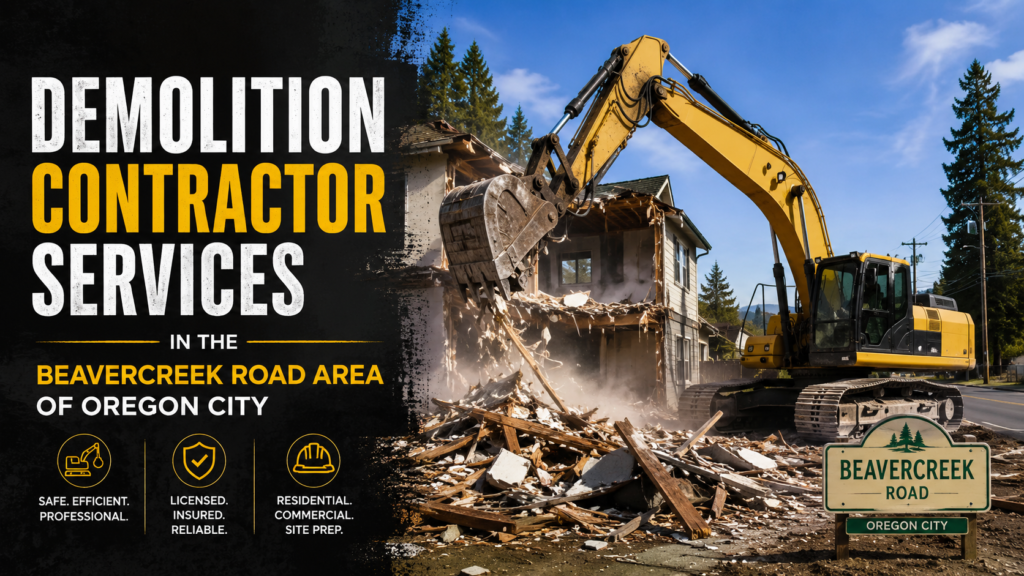
The Beavercreek Road corridor in Oregon City forms one of the primary access routes through Clackamas County, connecting the urban core of Oregon City with the more rural communities to the south. The area along Beavercreek Road encompasses a transition from established residential neighborhoods and small commercial properties near the city to more rural and agricultural land further south. This varied character creates a diverse range of demolition needs from residential outbuilding removal and old home teardowns to commercial structure clearance and site preparation for new development. Understanding what Demolition Contractor Beavercreek Road Area services involve in this specific area helps property owners plan effectively for what can be one of the most consequential early phases of any construction or renovation project.
The Character of the Beavercreek Road Area and What It Means for Demolition
Properties along and near the Beavercreek Road corridor vary significantly in age, construction type, and development context. Older homes dating to the mid-twentieth century sit alongside newer construction. Agricultural outbuildings barns, equipment sheds, and older farm structures are common on the rural properties along the corridor’s southern stretches. Commercial properties along the northern sections near Oregon City’s center include aging retail buildings and industrial structures that periodically require demolition or renovation.
This variety means that demolition contractors working in the Beavercreek Road area must be versatile capable of handling residential teardowns, selective interior demolition for renovations, outbuilding removal, and commercial structure clearance. Local knowledge of Oregon City’s permitting requirements and Clackamas County’s regulations is equally important, as the corridor crosses multiple jurisdictional boundaries.
Oregon State Requirements for Demolition Projects
Demolition in Oregon is regulated at both the state and local level. Key requirements affecting demolition projects in the Beavercreek Road area include:
- Oregon DEQ asbestos notification: Oregon’s Department of Environmental Quality (DEQ) requires notification before demolition of any structure that contains or may contain asbestos-containing materials. Structures built before 1981 must be surveyed by a certified inspector before demolition. If regulated asbestos is found, it must be removed by a licensed asbestos abatement contractor before structural demolition begins.
- Oregon CCB licensing: Demolition contractors in Oregon must be licensed with the Oregon Construction Contractors Board (CCB). Property owners should verify current CCB licensing before engaging any demolition contractor.
- City of Oregon City demolition permits: Structural demolition within Oregon City limits requires a demolition permit from the Building Department. Permit applications require utility disconnection confirmation and may require additional documentation for historic structures.
- Clackamas County permits: For properties in unincorporated Clackamas County along the Beavercreek Road corridor, permits are obtained through Clackamas County Development Services.
- DEQ solid waste requirements: Demolition debris must be disposed of at permitted facilities. Lead paint debris and other potentially regulated materials may require special handling.
Residential Demolition in the Beavercreek Road Area
Residential demolition in the Beavercreek Road area commonly involves the removal of:
- Accessory structures: Older detached garages, carports, storage sheds, and similar outbuildings that have deteriorated or are being removed to make way for new construction.
- Aging residential structures: Homes that have been damaged, are structurally unsound, or are being cleared for redevelopment. In this area, many structures date to the 1950s through 1970s when Beavercreek Road was first seeing significant residential development.
- Agricultural buildings: Barns, equipment sheds, and older farm structures on rural properties are a common demolition category along this corridor.
- Swimming pools and concrete features: In-ground pools and old concrete pads are frequently removed when properties are being repurposed or redeveloped.
For each of these project types, the pre-demolition sequence is the same: hazardous materials survey, utility disconnection verification, permit application, and abatement (if required) before structural work begins.
Asbestos and Lead in Older Oregon City Structures
The Beavercreek Road area includes significant numbers of structures built during periods when asbestos and lead were commonplace in construction materials. Asbestos was used extensively in insulation, floor tiles, ceiling tiles, roofing materials, and textured coatings through the late 1970s. Lead-based paint was standard in residential construction before 1978. Both materials require special handling during demolition.
Oregon’s asbestos notification requirement mandates that the Oregon DEQ be notified before demolition begins on structures of certain age and size. For residential structures with four or more dwelling units and commercial structures of any size, the notification requirements are explicit. For smaller residential structures, best practice is to conduct a survey regardless of regulatory trigger thresholds, because the health consequences of uncontrolled asbestos release are serious.
Debris Management and Recycling in the Portland Metro Region
The Portland metropolitan area within which the Beavercreek Road corridor sits as part of the Clackamas County fringe has a well-developed construction debris recycling infrastructure. Concrete, steel, and clean wood framing are routinely sorted and recycled from demolition projects in this region, diverting significant material volumes from landfill and recovering economic value from the demolished structure.
Demolition contractors working in the Beavercreek Road area who incorporate material recycling into their debris management programs reduce disposal costs and contribute to regional sustainability goals. Oregon has among the strongest recycling program infrastructure in the country, and property owners can ask demolition contractors about their material recovery and recycling practices as part of the contractor selection process.
Site Preparation Following Demolition
Once demolition is complete and debris is removed, the site must be properly prepared for its next use. This typically involves removal or excavation of foundation remnants if new construction will occupy the same footprint, backfilling excavated areas with clean compacted fill, rough grading to establish positive drainage away from adjacent structures and toward appropriate drainage outlets, and erosion control measures to protect exposed soil from the Pacific Northwest’s significant rainfall.
Oregon’s Department of Environmental Quality and local authorities regulate stormwater discharges from construction sites, requiring that erosion control measures be in place before ground disturbance begins. Demolition contractors in the Beavercreek Road area who include site restoration in their project scope can ensure that the cleared parcel is left in a condition appropriate for its next intended use.
Conclusion
Demolition contractor services in the Beavercreek Road area of Oregon City encompass a range of residential, commercial, and agricultural structure removal needs shaped by the corridor’s diverse character and history. Oregon’s regulatory requirements including DEQ asbestos notification, CCB contractor licensing, and local permit requirements establish the framework within which this work must proceed. Property owners who understand these requirements and what quality demolition practice involves are well-prepared to plan their projects effectively and select contractors who will execute the work safely, legally, and responsibly.